

SyncBoot: Digital Backend Framework Overview
Non-Developer & Evaluation Guide: For a plain-language product introduction, visit the SyncBoot Product Homepage (boot.empasy.io). For an installation-free interactive preview, explore the Unified Demo Portal. Product brochures and proposal PDFs are available in the Proposals Repository.
SyncBoot is a Java-based enterprise backend platform that understands business domain context to streamline database operations and API development.
Built on Spring Boot 4.0, AgentScope Java (io.agentscope:agentscope-harness), and the Model Context Protocol (MCP) standard, it delivers data CRUD, schema governance, full-stack code generation, and distributed log diagnostics.
4 Core Functional Areas
Domain CRUD Operations & Query Execution (Domain Operations):
- Enables querying and manipulating domain data through natural language queries and standard MCP tools.
- Processes data safely within authorized transaction boundaries.
Schema Design & 6-File SQL Standard (Schema Governance):
- Structures the 6-File SQL (
db/00_extensions.sql ~ 05_sample_dev.sql) layout according to business requirements. - Analyzes impact prior to schema modifications and applies changes to the database only after administrator pre-approval (Human-in-the-Loop).
- Structures the 6-File SQL (
Low-Code Full-Stack API & UI Generator (Low-Code Fullstack):
- Generates Controller, Service, Mapper, DTO, and Vue 3 screen code built with Vben Admin standard components (
BasicTable,BasicModal,BasicForm) from database entity metadata.
- Generates Controller, Service, Mapper, DTO, and Vue 3 screen code built with Vben Admin standard components (
Multi-Tenancy & RBAC Security (Enterprise Security):
- Supports tenant data isolation (both dedicated database and shared database models), column-level dynamic data masking, and row-level permission filtering.
5 Backend Worker Role Architecture
SyncBoot partitions domain management, security, batch processing, and protocol integration responsibilities across dedicated worker modules.
| Role Name | Key Responsibilities | Execution Mode |
|---|---|---|
| Domain Operator | Domain data model-based CRUD and business query processing | Autonomous execution |
| Schema Architect | 6-File standard DDL design, ERD diagram generation, and change impact analysis | Propose then developer approval |
| Security IAM | RBAC role/menu mapping, row-level data filtering, and sensitive data masking enforcement | Continuous policy enforcement |
| MCP Dispatcher | Standard Tool/Resource exposure for A2A communication with external systems and orchestrators | HTTP SSE protocol |
| Batch Orchestrator | High-volume data processing and distributed scheduling of periodic Quartz/Spring Batch jobs | Scheduler-driven execution |
Key Benefits
- Reduced Backend Development Effort: Cuts down the time required to write repetitive CRUD APIs and implement admin UI screens.
- Reliable DB Migrations: Reduces schema change risks through pre-change impact analysis and an approval console.
- Faster Log Collection & Root-Cause Analysis: Aggregates recent error logs from distributed servers to speed up troubleshooting.
- Standard Framework Compliance: Adheres to Spring Boot 4.0, AgentScope Java (
io.agentscope:agentscope-harness), OpenAPI 3.0, and Model Context Protocol (MCP) specifications.
Live UI Screens & Core Workflows
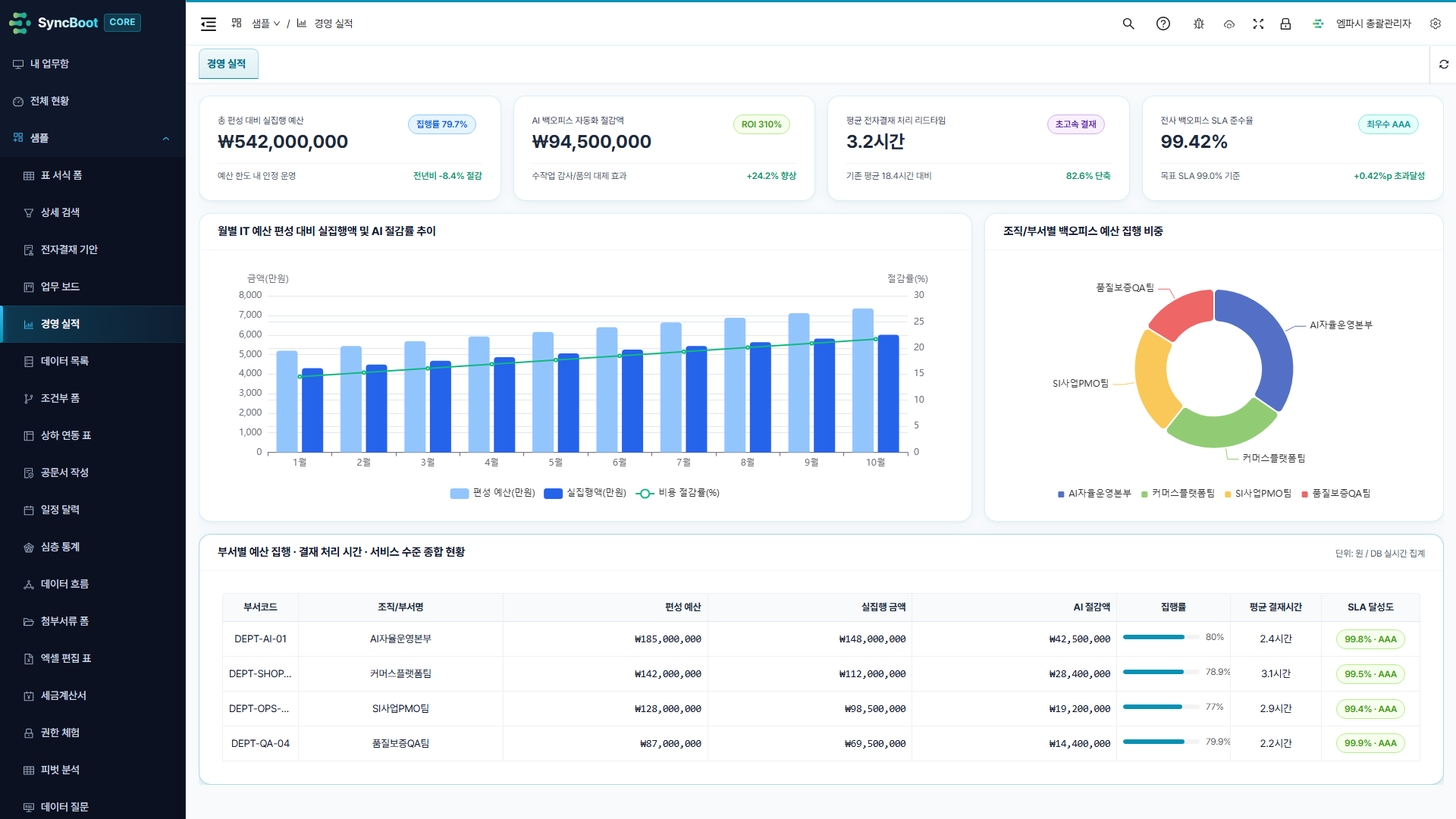
1. Back-Office Management Performance, Budget & Approval Lead-Time Dashboard
Monitors actual budget execution versus plan, AI back-office automation savings, average e-approval processing lead time, enterprise back-office SLA compliance rates, and departmental execution status in a single view.
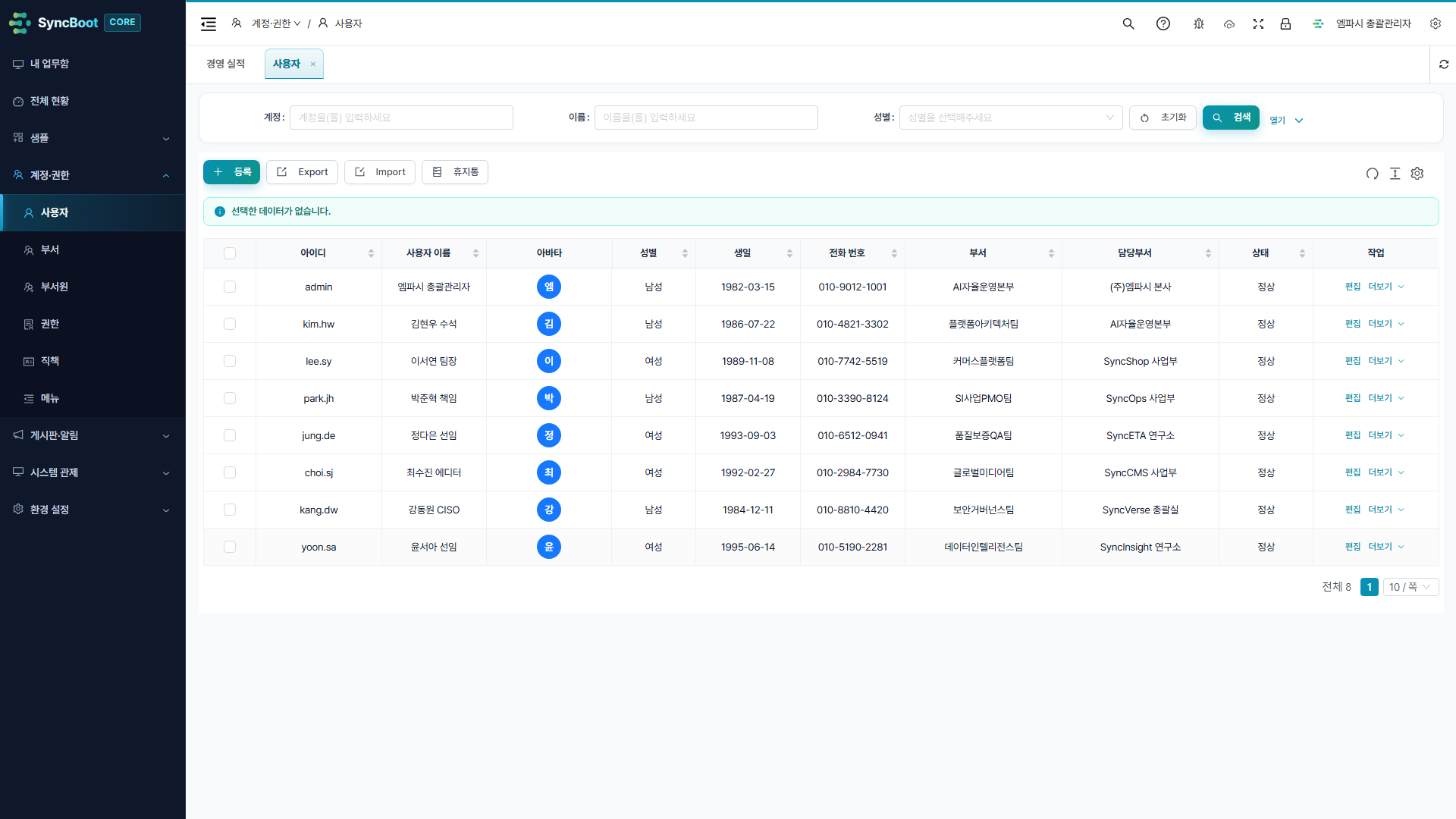
2. Organization-Linked User Accounts & Role-Based Access Control (RBAC)
Instantly manages user account ledgers linked to the organization/department tree, job role (RBAC) mappings, and menu/button-level access permissions from a single database source of truth.
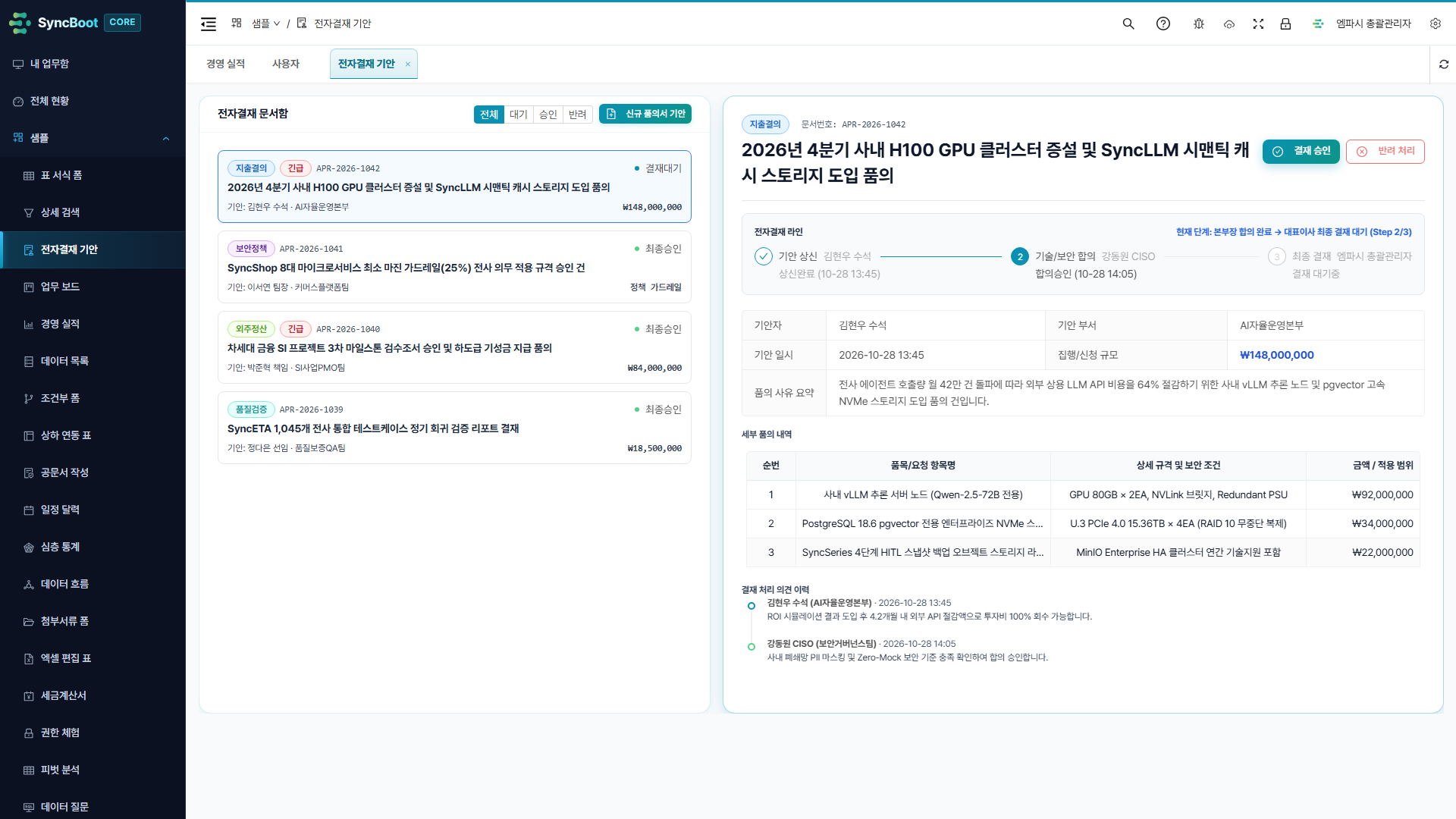
3. Korean-Style E-Approval Inbox & Multi-Step Approval Line Wizard
Includes built-in Korean-style e-approval document boxes (expense claims, security policies, vendor settlements, quality verification) along with multi-step approval line workflows—from draft submission to technical/security concurrence and final approval—and itemized request details.
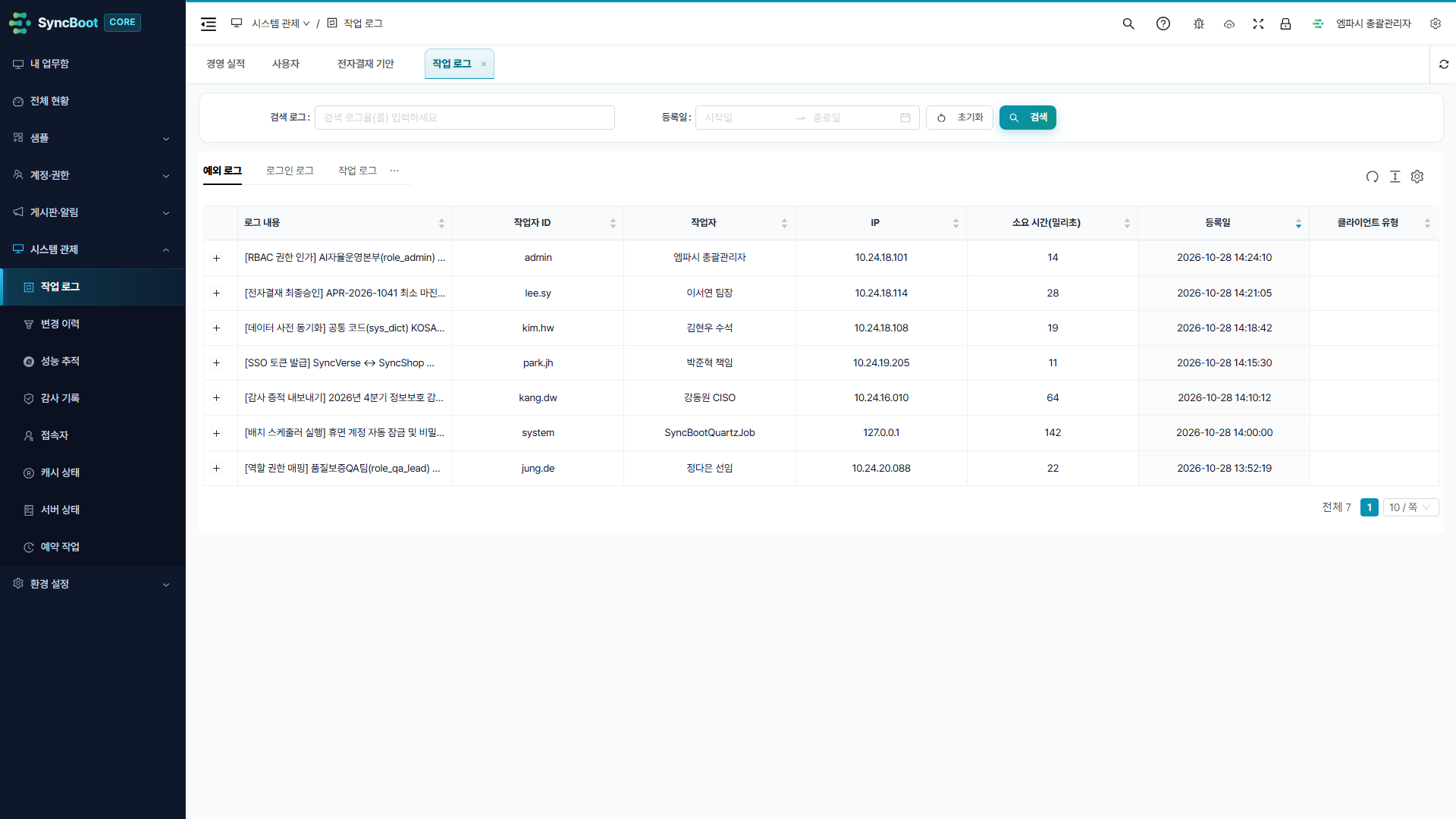
4. Real-Time Authorization, E-Approval & Batch Scheduler Audit Logs
Centrally tracks enterprise back-office activity history—including permission grants, final e-approval sign-offs, common code synchronization, SSO token issuance, and scheduled batch runs—along with actor IP addresses and execution durations.
Documentation Index
- 5-Minute Quickstart Guide - Running the local environment with Docker Compose
- System Architecture & Module Structure - 4-layer architecture and worker roles
- Intelligent Schema Studio - 6-File SQL standard and DDL approval workflow
- Low-Code Full-Stack Generator - Backend API and Vue 3 UI code generation
- Multi-Tenancy & RBAC Security - Row-level security and data masking
- Batch & Job Scheduler - Managing Spring Batch and Quartz jobs
- AgentScope Java & MCP Integration - Model Context Protocol tool specifications
- Production Deployment & Benchmarks - Container deployment and performance metrics
- PostgreSQL 18.6 Local Container Environment - Zero-Mock local development and test DB configuration