SyncVerse: Multi-Agent Central Control and Orchestration Platform
For Non-Developers & Evaluation Teams: Explore an accessible product overview on the SyncVerse Product Website (verse.empasy.io), try the no-install UI experience in the Unified Demo Portal, or download brochures and proposal PDFs from the Proposals Library.
SyncVerse is a central orchestration platform (Control Tower) that connects independently operating, distributed domain solutions through standardized interfaces to unify requirements organization, task delegation, quality verification tracking, and multi-stage approval workflows.
The SyncVerse central orchestrator communicates with subordinate domain modules (SyncWatch, SyncAPIM, SyncBoot, SyncCMS, SyncShop, SyncOps, SyncLLM, SyncInsight, SyncETA, SyncCrawl) over standard MCP and A2A protocols. In addition, it inspects repository vulnerabilities and generates patch PR drafts based on the VerseAuditPack (SCA dependency, SAST code, and DAST inspection rule pack) received from SyncWatch.
1. Four Core Components
SyncVerse provides four core engines to support the end-to-end software development and operations lifecycle (AI DLC).
| Core Engine | Role and Capabilities | Key Technical Mechanisms |
|---|---|---|
| 01. Natural Language Intent Classification & A2A Delegation | Determines whether an incoming request is an operational data task or a source code change task and delegates it to the appropriate domain module | A2ASwarmDelegationStrategyHandler, domain-context Tri-Hybrid RAG injection |
| 02. 5-Step Spec Studio | Acceptance Criteria (AC) refinement -> detailed technical specification -> implementation plan -> branch task delegation -> reverse sync of four standard artifacts | Decision Queue, Living Spec, Requirements Coverage Matrix |
03. Multi-Coding Engine SPI Routing (SyncSDK) | Selects an active coding adapter registered under enterprise policy when modifying source code and generates patches on an isolated branch | CodingAgentRoutingProxy (ICodingAgentClient plugin adapter architecture) |
| 04. Automated Deployment Integration & Self-Healing Recovery | 4-Cycle build error analysis and remediation, plus snapshot-based compensating rollback on deployment failure | sync-module-deploy, Multi-Party HITL approval chain, snapshot compensating rollback |
2. 6-Step AI DLC Lifecycle
SyncVerse tracks pipeline status across six stages, from requirement intake through approval and deployment.
- Requirements Analysis and Spec Refinement (Spec Studio Steps 1–3): Analyzes requirement prompts to generate Acceptance Criteria (AC), technical specifications, implementation plans, and a Requirements Coverage Matrix.
- Isolated Branch Code Authoring (Spec Studio Step 4): Authors source code and 6-File DB SSOT (
db/00_extensions.sql~05_sample_dev.sql) DDL change proposals on an isolated working branch through theSyncSDKadapter. - Automated Regression Verification (Automated QA): Executes automated builds alongside Playwright and
SyncETAE2E regression tests. - Build & Test Error Remediation (4-Cycle Self-Healing Loop): When compilation or tests fail, collects distributed logs to perform root-cause analysis and retry patching.
- Multi-Party Architect Approval (Multi-Party HITL Approval): System architects review code diffs and impact analysis reports to approve or reject across multi-stage approval chains.
- Deployment and Artifact Reverse Sync (Spec Studio Step 5): Passes approved changes to the deployment pipeline and updates the four standard artifacts (Requirements Definition, Screen Design Specification, DB Design Specification, and Test Results Report).
3. Operational Architecture Comparison (Manual Operations vs. SyncVerse Central Control)
| Category | Individual Manual Development & Operations | SyncVerse Central Control Architecture |
|---|---|---|
| Requirements Specification Tracking | Specs, issues, and code diverge, causing change history drift | Specification, implementation, and artifacts stay reverse-synced via 5-Step Spec Studio |
| Code Change Workflow | Tooling fragmentation and manual branching/verification procedures per developer | Isolated branch creation and consistent verification gates via the SyncSDK standard SPI |
| Incident Root-Cause Analysis & Re-verification | Manual server log collection and reproduction upon errors | Automated cluster log collection linked with 4-Cycle build and test re-verification |
| LLM Cost Control | Per-team individual API keys make cost tracking and limits difficult | Unified SyncLLM gateway, Semantic Cache, and FinOps budget caps |
| Tool & Module Governance | Fragmented standalone tools prevent auditing and access control | Centralized management via the standard MCP registry and RBAC |
| Deployment Safeguards | Manual rollbacks and late-night incident response overhead | Multi-Party HITL pre-approval gates and snapshot compensating rollback |
4. Enterprise Security and Reliability Principles
SyncVerse enforces the following governance rules to safeguard core enterprise business assets:
- Private AI Security Environment: Supports on-premises and private cloud (VPC) deployments for sensitive data that must never leave the corporate network.
- Multi-Party HITL Safety Gates: Enforces multi-party approval chains by policy for high-impact operations such as DDL changes, permission updates, and production deployments.
- Direct Live Service Integration (Zero-Mock): 100% directly integrated with live PostgreSQL 18.6 databases and backend services without hardcoded dummy logic.
- Enterprise Audit Trail & KMS: Records all task issuers, approval histories, and agent tool invocations, and supports one-click AES-256 master key rotation.
Live Runtime Screens & Core Workflows
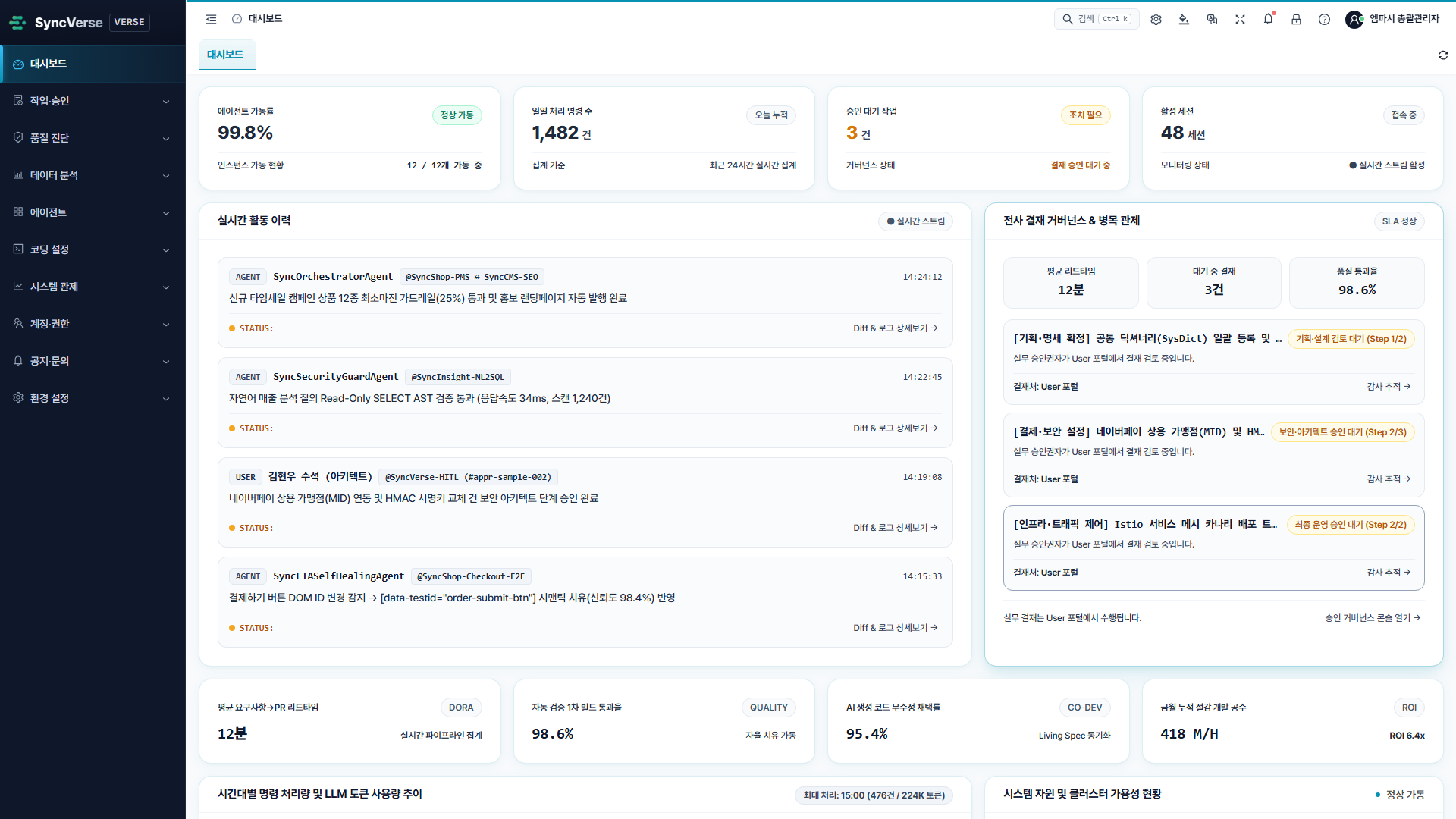
1. Unified Command Center and Agent Topology Monitoring
Receives natural language business directives, routes intent to subordinate domain agents (SyncBoot, SyncCMS, SyncShop, SyncOps, SyncAPIM, SyncWatch, etc.), and monitors real-time A2A collaboration status.
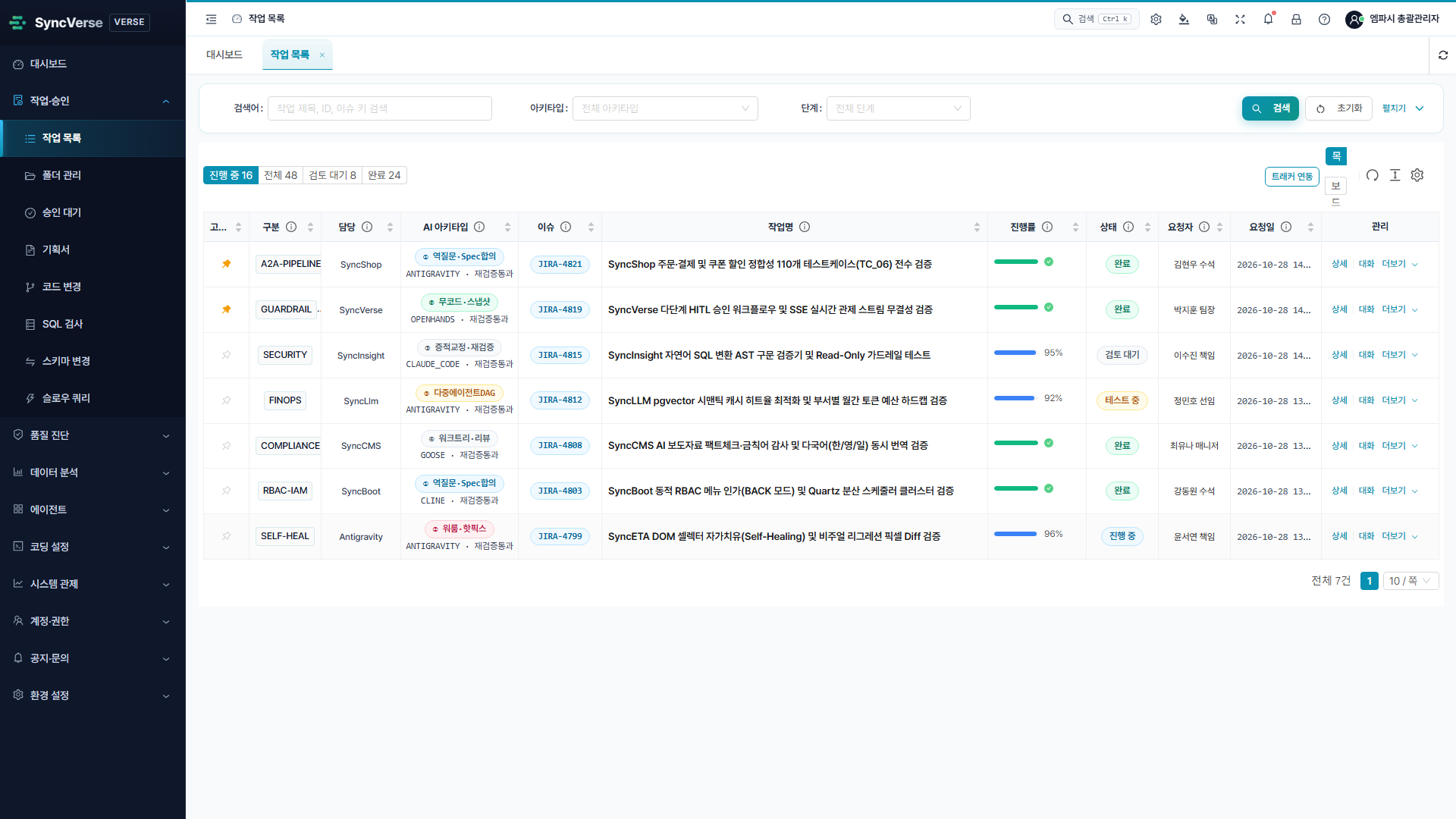
2. Enterprise Autonomous Agent Tasks and Quality Verification Pipeline Monitoring
Tracks autonomous tasks delegated to domain agents, AI archetypes (clarification & spec consensus, no-code & snapshots, visual regression & self-healing, etc.), and quality verification pipeline progress and status in a single view.
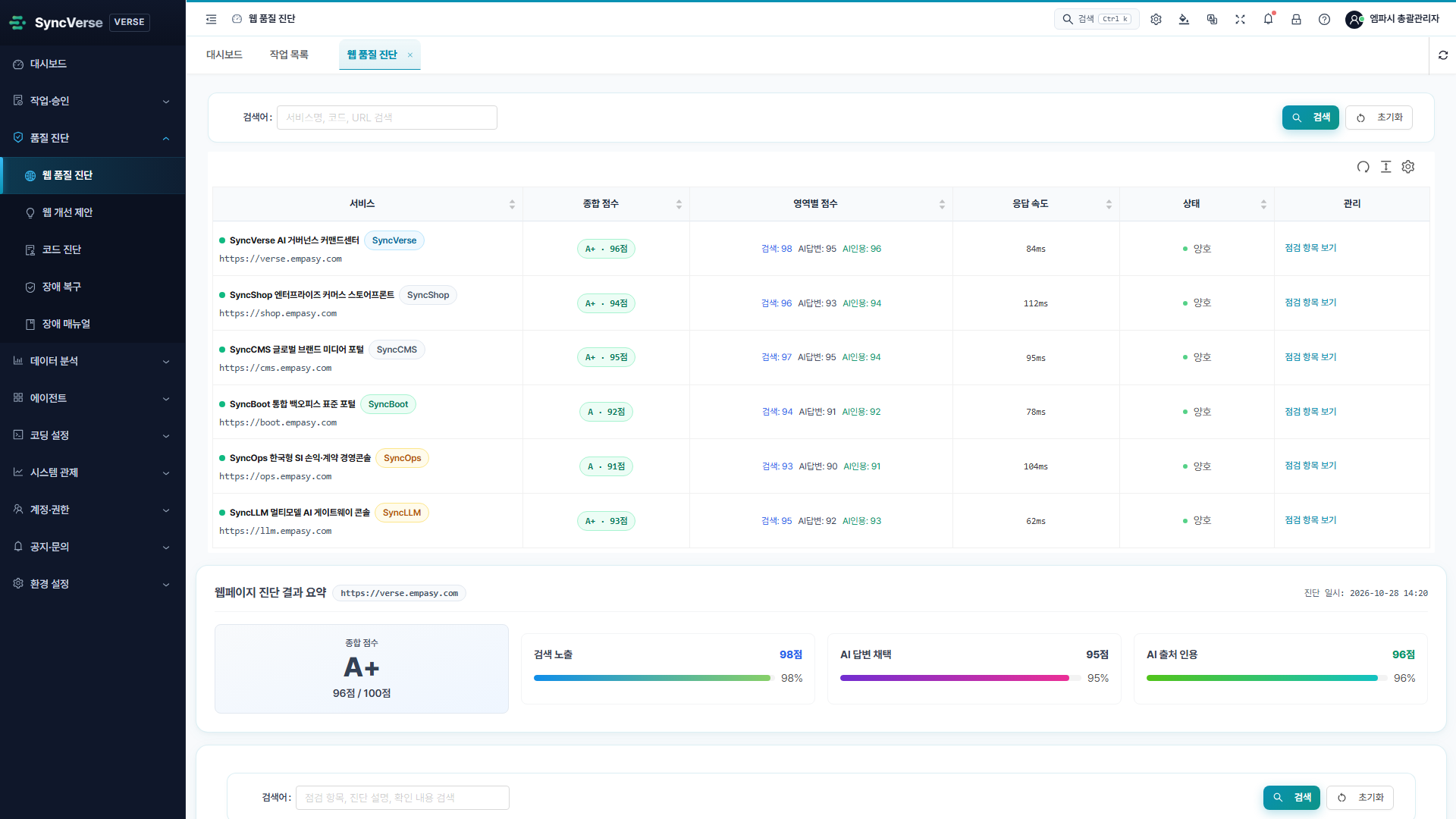
3. Unified Web Quality and Repository Security Audit
Combines headless browser rendering with security inspection rules to continuously diagnose web quality scores (SEO/AEO/GEO) and repository security vulnerabilities.
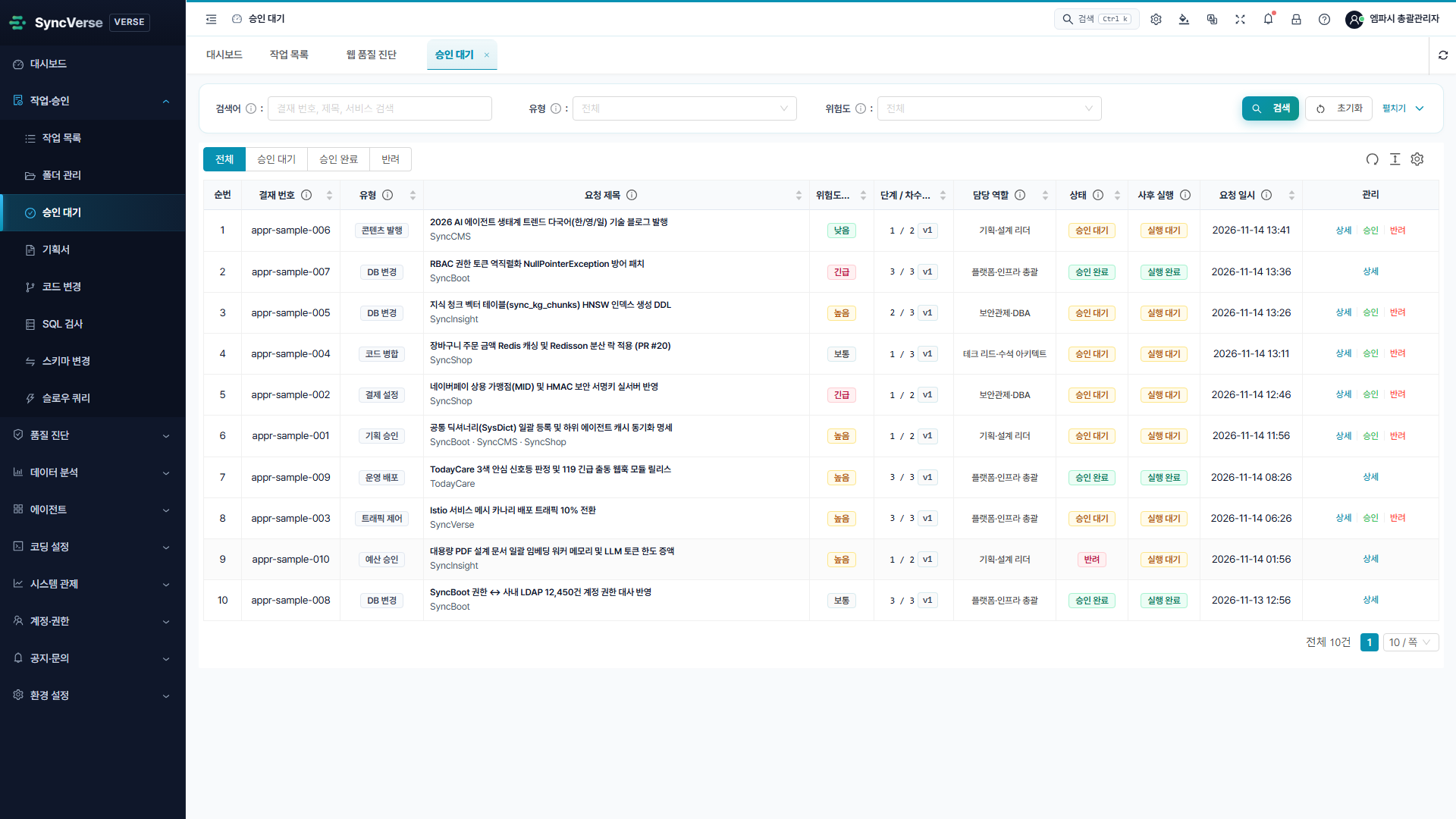
4. Multi-Party Approval and Snapshot Rollback Center
Reviews before-and-after diffs and impact analysis for high-risk DDL changes, source code patch PRs, and production deployments, enabling multi-party approval or one-click snapshot rollback.